
What role for European allies in Greenland?
Donald Trump's Greenland threats are chipping away at NATO's foundations

US President Donald Trump’s statements about Greenland’s ownership are yet again rattling NATO’s unity and raising questions over Europe’s ability to deal with his inflammatory rhetoric.
“I would like to make a deal, you know, the easy way. But if we don’t do it the easy way we’re going to do it the hard way”. (Donald Trump, 10 January 2026)
What the “hard way” is exactly remains rather unclear, even if a hostile takeover appears to be presented by Trump and some of his staff as the not-so-implicit alternative to a negotiated deal. While it may be tempting to see Tump’s maximalist and overtly aggressive approach to the issue as merely a negotiation tactic, some European leaders have taken it seriously enough that they have released a joint statement on 6 January, signalling their support for Denmark and arguing that Arctic security “must therefore be achieved collectively, in conjunction with NATO allies”. The statement, signed by the French President, the German Chancellor, and the Italian, Polish, Spanish, British, and Danish prime ministers, may be a remarkable sign of concern by some of Europe’s largest countries — but it cannot possibly scratch the surface of the trouble continued American Pressure on Denmark would spell for the cohesiveness of the NATO alliance and more broadly for US influence in Europe.
Greenland’s strategic importance
While the Arctic is becoming increasingly crowded as a result of strategic competition and climate change opening up new trade routes, Trump’s claims that waters around Greenland are infested with Chinese and Russian warships and submarines are heavily exaggerated according to other Western countries operating in the Arctic.
As has been amply reported, a 1951 treaty signed by Washington and Copenhagen already provides for a cooperation framework between the two allies with regard to the security and defence of Greenland. While some have said the treaty essentially gives the US a free hand in establishing new military bases and installations, this is inaccurate, as the 1951 treaty requires both parties to agree on the establishment of new ‘defence areas’. Thus, Denmark and indeed Greenland (which is now a party to the treaty on account of having been become an autonomous territory of the Kingdom of Denmark and having signed a 2004 agreement which amends and complements the previous one) both must agree to new defence installations — something they would have almost been guaranteed to do until now. Nevertheless, the treaty does not put formal limits to what military capabilities the US can station in agreed-upon defence areas, meaning that Washington is already legally allowed to robustly enhance Greenland’s defences in existing areas.
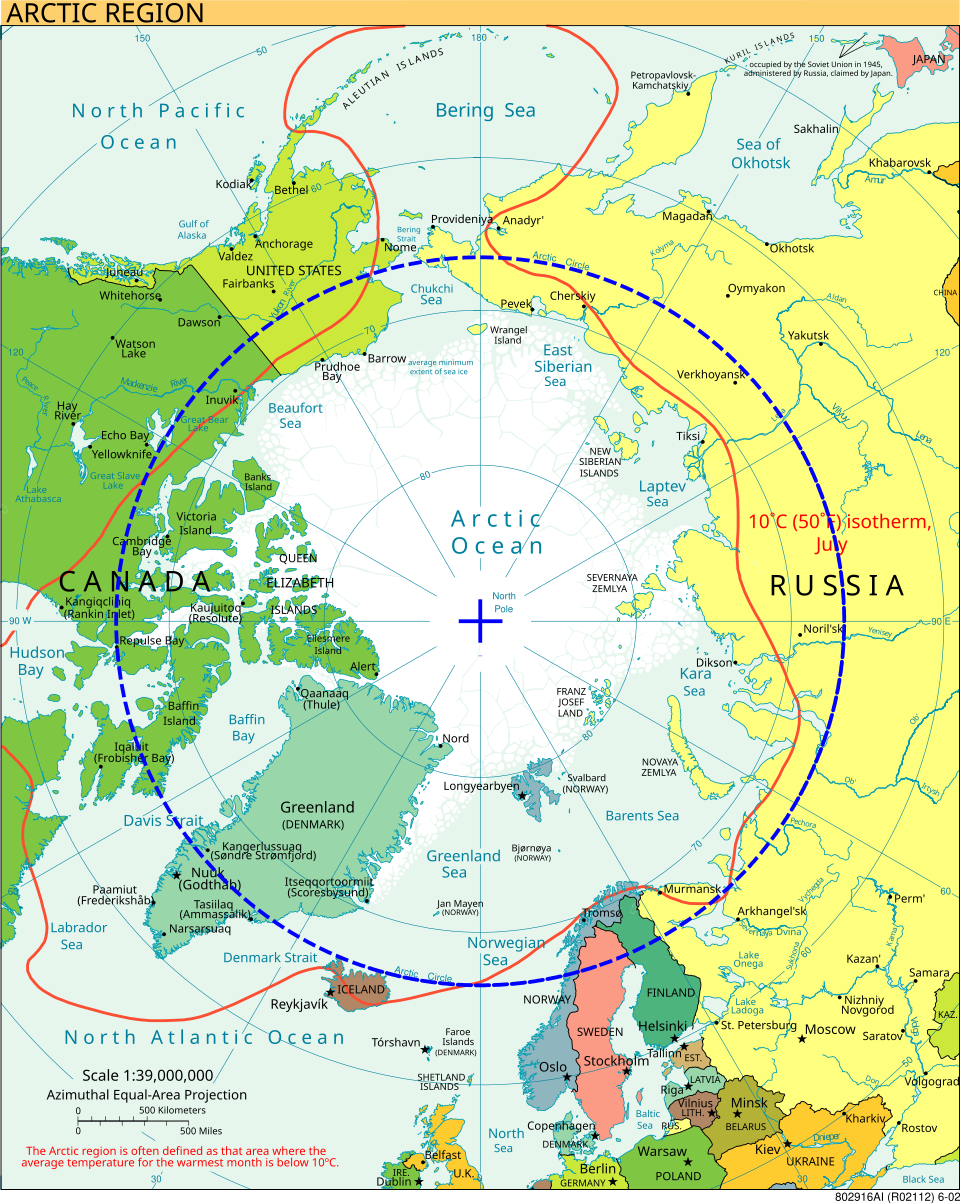
However destabilising Trump’s words may be for transatlantic relations, and leaving aside the wealth of raw material and resources that the island offers, Greenland does in fact play an outsized role in US security. A map of the Arctic Ocean and the surrounding areas reveals how, from a US perspective, the Arctic represents the shortest route for ballistic missiles launched from Russia and China. For the same reason, the Arctic Ocean — even with its retreating ice sheets — is an ideal hiding place for ballistic missile submarines. Greenland is therefore a valuable platform from which to carry out early warning activities, along with northern Alaska and Canada. For this reason, the US Department of Defence has re-assigned Greenland to US Northern Command when it had previously been under US European Command.
The DoD’s Arctic Strategy from 2024, drafted during the Biden Administration, outlined a number of steps necessary to avoid that the Arctic become a “strategic blind spot”. Crucially, it highlighted the importance of working constructively with allies and partners as a necessary precondition for US security.
Yet the US has abandoned most of its bases in Greenland following the end of the Cold War. As of today, only Pituffik Space Base survives with less than 200 personnel stationed there. Pituffik is the US’ northernmost military installation and comprises an air base, docking facilities, and a substantial number of early warning radars contributing to North American Aerospace Defence Command (NORAD). It also provides a strategic location from which to contact polar-orbit satellites multiple times a day. Interestingly, the regained importance of Greenland for US defence has not yet led to a commensurate increase in investment in the territory by Washington, with Pituffik itself still lacking adequate defences in the face of rising threats, according to some experts.
What’s more, the recent White House rhetoric regarding Greenland will clearly work against a partnership-focused approach to Arctic security, assuming that is still considered to be a desirable method.
A European-led NATO mission?
Washington’s European allies have but a few options as they try to present a united front against Trump’s push for Greenland. Other than strengthening their naval presence in the area, dispatching a small European force — as the UK and Germany are currently discussing — could serve two purposes. Firstly, it would show the US that Europeans are willing to act on the Trump Administration’s concerns with regard to Greenland being open to a Russian and Chinese takeover, and taking serious ownership in defending a vast, strategic territory that Denmark alone cannot hope to protect. Under a NATO umbrella, such a mission could be sold as a victory domestically by President Trump, who could claim to have forced the Europeans to step up in defending Greenland and bolstering US defences in North America. Secondly, the stable presence of a European-led NATO force in Greenland — however small — would make a hostile takeover even more unpalatable and unlikely than it should already be when only Danish troops are stationed there.
This scenario would entail a number of significant challenges. First of all, Greenland’s climate and geography are hugely inhospitable and sustaining a mission there would require a disproportionately large effort in terms of logistics (as the US’ own limited presence in Pituffik demonstrates). Secondly, European forces presently have little to spare in terms of air defence systems and other key capabilities that would provide sufficient protection to troops and assets deployed to Greenland if they are to be more than just a token force. As such, a mainly European, ad hoc NATO mission in Greenland would inevitably divert some precious resources from the European continent. Lastly, a military presence without a pragmatic and long-term plan on how to better defend Greenland from rising threats risks becoming a useless and costly exercise. Should NATO members agree that Greenland needs better defences, discussions should take place on whether new bases are needed in order to fill the security gaps left by the Americans after the Cold War. If no added value can be provided at a reasonable cost, then the Europeans may still end up having to deploy a NATO force simply to appease the current US Administration. While such an outcome may in the short term address President Trump’s security concerns, it will likely still leave a door open to future complaints from Washington.
Conspicuously, this analysis does not take into account two crucial elements: the will of the autonomous government and people of Greenland, which have hitherto rejected any prospect of US control, and the presence of vast deposits of strategic natural resources and rare earths on the island. This second element especially may indeed be of central importance to the US Administration’s posturing over Greenland. The US’ leading Allies in Europe have no choice but to try and convey the message that Trump’s security concerns are in fact taken seriously and that cooperation will yield greater results than unilateral takeovers. Whether genuine or instrumental to a negotiation strategy, Trump’s rhetoric on this and other transatlantic issues has already started chipping away at NATO’s very foundations, which are built on mutual interest, trust, and restrained leadership by the US.
Very clear and informative piece, thanks Elio!